
Studying abroad has long been a dream for many Indian students seeking global exposure, high-quality education, and strong career opportunities. While traditional destinations such as the United States, the United Kingdom, and Canada once dominated this landscape, a clear shift is now emerging. Germany and France are becoming increasingly popular choices for Indian students.
Affordable education, student-friendly visa policies, and growing academic collaborations with India are driving this shift. Let’s explore why student enrolments are rising—especially in Germany, where Indian student numbers have surged by nearly 20%—and how France is actively positioning itself as a preferred destination.
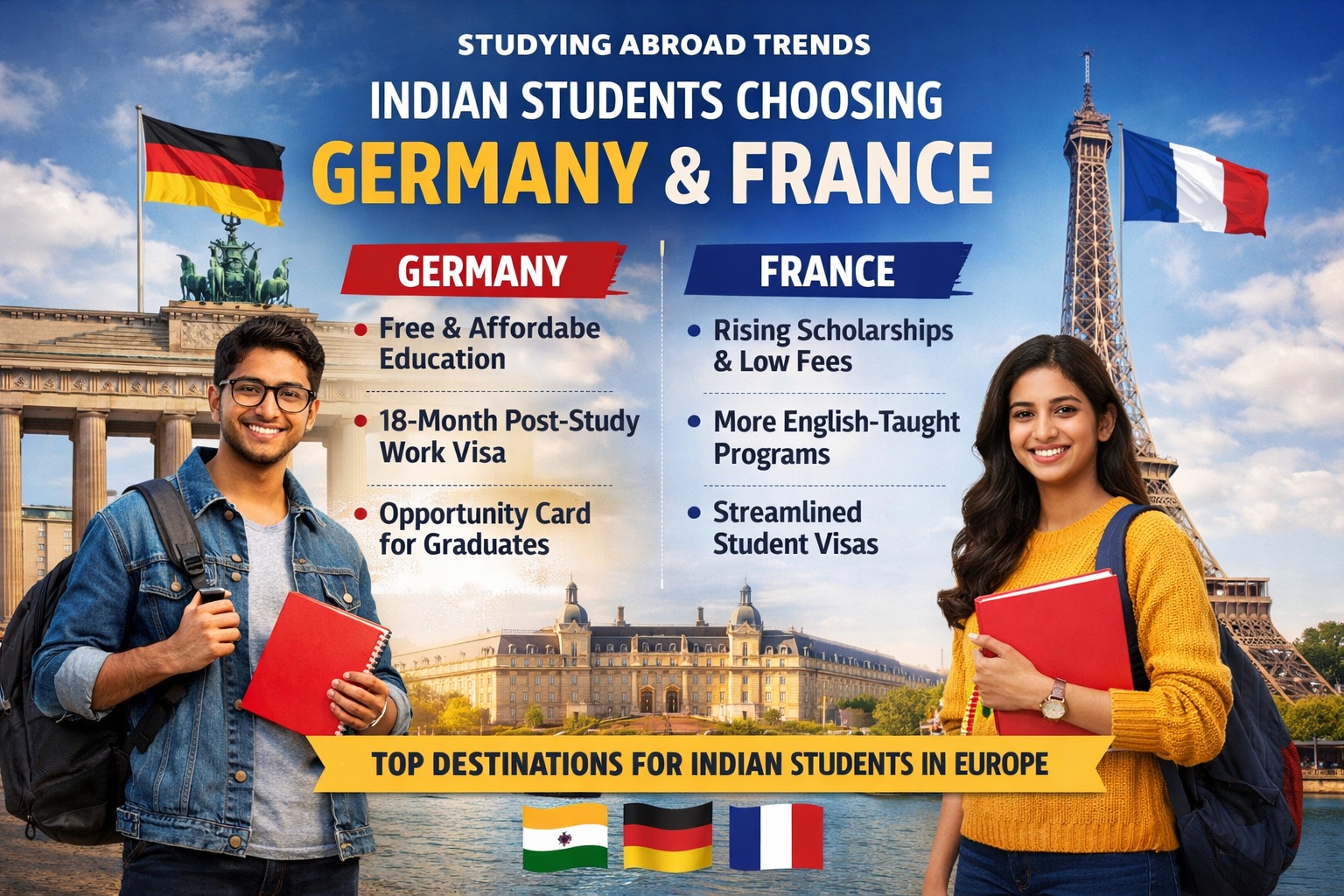
Rising Enrolment of Indian Students in Germany and France
Recent data shows that the number of Indian students at German universities has increased by approximately 20% year-on-year, bringing the total close to 60,000 students as of August 2025. India is now one of the largest sources of international students in Germany.
Several key factors are driving this growth.
Affordable or Free Education
Most public universities in Germany do not charge tuition fees, even for international students. Students typically only pay a small semester contribution. This makes higher education far more affordable compared to countries like the USA or the UK, where annual tuition fees can exceed €30,000.
English-Taught Programs
Germany offers more than 2,400 English-taught programs, including many bachelor’s and master’s degrees. This reduces the language barrier for Indian students who may not speak German initially.
Predictable and Student-Friendly Visa Policies
Germany’s visa system is known for being transparent and reliable. Students can benefit from an 18-month post-study job-seeking visa, giving them enough time to find employment after graduation.
Opportunity Card (Chancenkarte)
Germany has also introduced the Opportunity Card (Chancenkarte), which allows skilled graduates to stay in Germany while searching for employment even without a prior job offer.
These education and career-oriented policies make Germany a highly attractive and predictable study destination for Indian students compared to some traditional destinations where visa rules and costs have become more restrictive.
France’s Growth Strategy
France is also rapidly increasing its appeal among Indian students. The French government recently announced ambitious plans to increase the number of Indian students from around 10,000 to 30,000 annually by 2030.
This strategy is supported by easier visa policies and stronger academic partnerships with Indian institutions.
Visa Alignment With Study Duration
France is working to simplify visa processes by aligning visa validity with the full duration of academic programs. This reduces the need for frequent renewals and administrative procedures.
Expansion of English-Medium Programs
Traditionally, French was the primary language of instruction. However, many universities now offer English-taught undergraduate and postgraduate programs, making French universities more accessible to international students.
Affordable Education and Scholarships
Tuition fees at French public universities are relatively low. Additionally, scholarships such as the Charpak Scholarship and the Eiffel Excellence Scholarship help reduce financial pressure for international students.
Growing Academic Partnerships
Academic collaborations between India and France are expanding rapidly. Initiatives such as the Indo-French Centre for AI in Health highlight the deepening research and innovation partnerships between the two countries.
Why Indian Students Are Choosing Germany and France
For many Indian families, cost is a major factor when choosing a study abroad destination. Germany’s tuition-free public universities and France’s subsidised education system provide affordable access to high-quality international education.
Both countries are also implementing student-friendly immigration policies, including longer post-study work visas and streamlined application processes designed to attract global talent.
Top universities such as the Technical University of Munich, Humboldt University, Sorbonne University, and Sciences Po offer world-class education, strong research opportunities, and close industry connections across fields like engineering, science, business, and humanities.
Studying in Europe also exposes students to multicultural environments, global research networks, and access to major European business hubs, significantly enhancing both academic and personal growth.
The rise of Germany and France as preferred destinations for Indian students reflects a broader shift in global education trends. While traditional destinations remain popular, Europe is becoming increasingly attractive due to its affordability, safety, stable visa policies, and strong post-study opportunities.
With enrolment numbers continuing to rise—such as Germany’s recent 20% increase in Indian students—more Indian learners are discovering that world-class education does not always come with extremely high costs or uncertain immigration policies.
As Germany and France strengthen their educational partnerships with India, the opportunities for Indian students in Europe will continue to expand in the coming years.


