
As 2026 unfolds, international education feels noticeably different from what it was even a few years ago. Studying abroad is no longer simply about choosing a country, securing admission, and moving overseas for a degree. Students today are thinking far more strategically. They are asking tougher questions: Will this course build real-world skills? What are the post-study work options? How stable are immigration policies? How does this degree align with long-term career plans? The conversation has shifted from “Where should I go?” to “What will this experience enable me to become?”
What’s Changing in International Education This Year?
One of the biggest changes in 2026 is the growing comfort with flexible learning formats. While campus life remains an important part of the international experience, many universities now offer blended structures that combine online coursework with shorter on-Campus residencies. This approach reduces costs and allows students to begin their studies from home before transitioning abroad. For families concerned about financial planning or global uncertainties, this flexibility provides reassurance. Technology has also matured in ways that make hybrid education far more meaningful than it once was. Virtual collaboration tools, global classrooms, and industry-led online projects are no longer temporary alternatives—they are integrated into mainstream academic design. Students can now work on cross-border group projects or attend guest lectures from global industry leaders without being physically present.
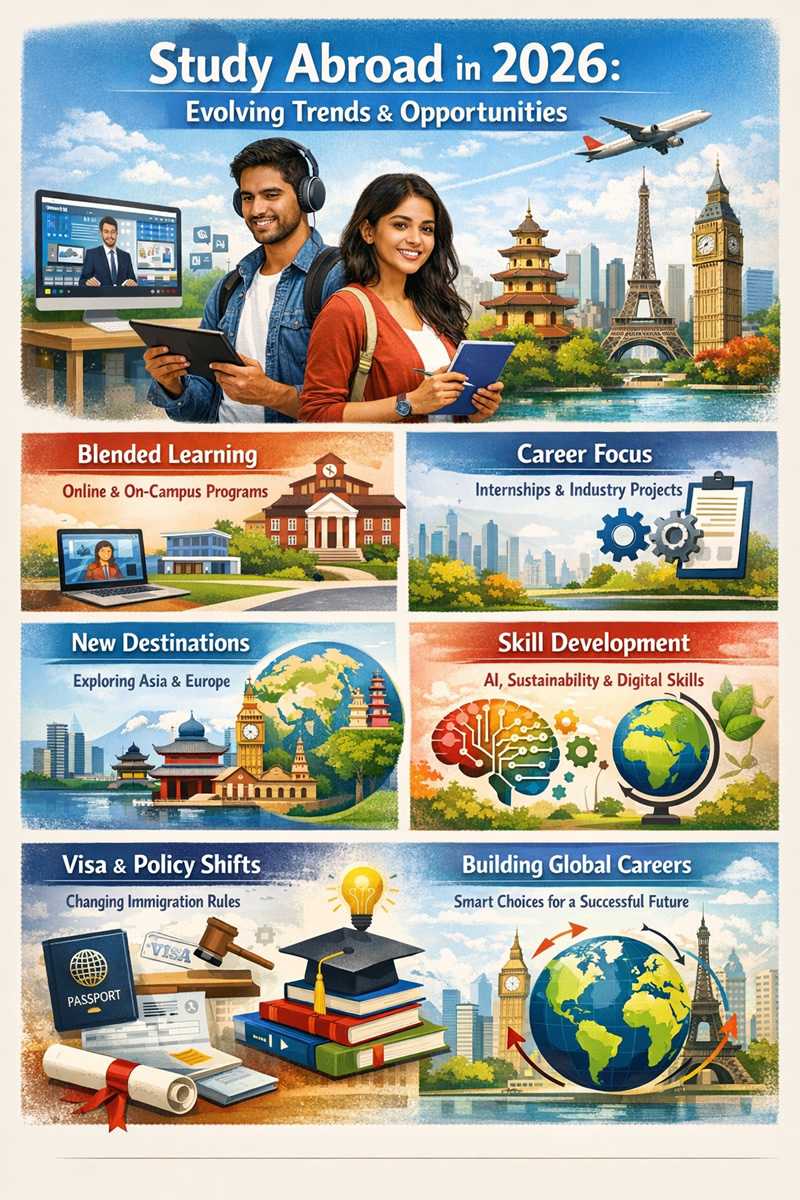 An additional discernible change is the emphasis on employability. Internships, live consulting assignments, and industry relationships are becoming increasingly important to universities. Companies are speaking out more and more about the need for recent grads who can make an impact right away. As a result, academic theory and applied problem-solving are being blended into more practical programs. Preferences for destinations are also changing. Even though nations like the US, UK, Canada, and Australia still draw a lot of students, many are now looking into other options that provide higher academic standards and more defined post-study career paths. Countries in Asia and Europe are making significant investments in fields that are driven by innovation and programs taught in English. This offers students more options and possibly a higher return on investment.
Mobility, Skills, and Career Trends: What Experts Are Observing
Education counsellors and university advisors are observing more thoughtful mobility patterns in 2026. Students are no longer automatically gravitating toward traditional destinations. Instead, they are comparing visa rules, employment rates, living costs, and long-term settlement prospects before making decisions.
Indian students, in particular, are becoming highly research-driven. Many are considering countries that offer structured post-study work rights and transparent residency routes. Affordability has also become central to decision-making, especially as global living costs fluctuate.
When it comes to career preparation, adaptability stands out as the defining skill of this decade. Programs that integrate digital literacy, artificial intelligence fundamentals, sustainability, and cross-cultural communication are gaining popularity. Employers want graduates who can think critically, collaborate globally, and adapt quickly to technological change.
Another emerging pattern is the acceptance of lifelong learning as a norm. Instead of viewing education as a one-time investment, students increasingly see it as a continuous process. Short-term certifications, stackable credentials, and specialized master’s programs are becoming stepping stones within longer career journeys. Universities are responding by offering flexible learning pathways that allow professionals to return and upskill as industries evolve.
The Impact of Global Policies on Indian Students
Government policies continue to play a significant role in shaping study-abroad decisions. In 2026, several destination countries are refining visa frameworks to attract skilled international graduates. Extended post-study work opportunities and clearer employment transition routes have become major influencing factors for Indian students.
However, policy shifts can also create uncertainty. Changes in immigration caps, financial proof requirements, or compliance regulations can alter application strategies. This makes staying informed more important than ever. Families are planning earlier, consulting advisors more frequently, and diversifying their application choices to reduce risk.
At the same time, scholarship collaborations and bilateral education partnerships are expanding. Many governments recognize the economic and cultural contributions of international students. As a result, funded programs in areas such as technology, healthcare, sustainability, and innovation are increasing. These initiatives not only make global education more accessible but also strengthen international academic cooperation.
Study abroad in 2026 is more intentional, skill-focused, and policy-aware than ever before. Students are not just seeking degrees—they are building global careers. Flexibility in learning formats, stronger industry alignment, and evolving immigration pathways are reshaping how international education works.
For Indian students especially, this is a period of opportunity balanced with responsibility. Careful research, financial planning, and clarity of long-term goals are essential. Those who approach international education with adaptability and foresight will find that studying abroad in 2026 is not simply about changing locations—it is about expanding possibilities in a globally connected world.


