
CAMBRIDGE 12
LISTENING CAM-12
READING -ACADEMIC CAM-12

READING-GENERAL CAM-12
WRITING- GENERAL CAM-12
WRITING- ACADEMIC CAM-12

The diagram below shows how geothermal energy is used to produce electricity.
Summarise the information by selecting and reporting the main features, and make comparisons where relevant.

Sample Report
The diagram displays how a geothermal power station generates electricity.
Overall, the station produces electricity in five main steps: pumping cold water underground, heating it, pumping heated water to the surface, converting it into steam, and using the steam to turn the turbine to create electricity.
First of all, cold water stored in the container is pumped down to the injection well that is 4.5 kilometers deep beneath the Earth’s surface. The well then injects the water into the geothermal zone where it is heated by hot rocks.
The superheated water is subsequently pumped above ground and into the condenser. Here, its pressure is lowered, which turns it into steam. As the steam passes through the turbine, it drives its blades to rotate. The spinning turbine then powers the generator connected to it to create electricity. Finally, the electricity generated is delivered to the power grid through power lines.
In a number of countries, some people think it is necessary to spend large sums of money on constructing new railway lines for very fast trains between cities. Others believe the money should be spent on improving existing public transport.
Discuss both these views and give your own opinion.
Sample Essay
Some countries are spending heavily on building new high-speed rail. While this might drive their economies forward, I believe the money should go toward upgrading public transport systems that already exist because they have a greater effect on people’s daily lives.
On the one hand, high-speed trains can be a key economic driver. This is because they allow people to travel at much lower prices than flights and in a much shorter time than traditional trains. Such fast, inexpensive travel can encourage people to visit other cities, injecting vast sums of money into the local economies. However, I think there might be little demand for some routes and those unprofitable ones could make it hard for governments to pay off the debt, which could prevent them from investing in other projects to improve the economies.
On the other hand, public transport that already exists plays a more important part in people’s daily lives. Many people use high-speed trains only occasionally but take buses or subways every day, making them an indispensable part of their daily lives. If, for example, the problems with delays and overcrowding in New York City subways are resolved, many New Yorkers can arrive at work on time in a better mood. Therefore, I think improving existing public transport will be worth the money.
In conclusion, although building high-speed rail networks might be good for the economy, I think the money would be better spent on the improvement of existing public transport systems because they play a more important role in people’s everyday lives.
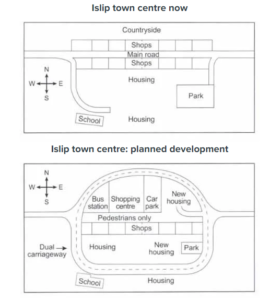
The maps below show the centre of a small town called Islip as it is now, and plans for its development.
Sample Report
The maps display the current layout of the center of a small town, Islip, and how it is planned to develop it.
Overall, the town center is to be brought up-to-date, with the construction of some modern facilities and more housing.
There is a main road running east-west through the town center. This road has two side roads, one leading to the school southwest of the town center and the other to the park in the southeast. While the main road is to be pedestrianized, the two side roads are to be turned into a dual carriageway, extending to the countryside north of the town center.
All the shops north of the main road are to be demolished to make room for a shopping center, which is to have a car park and bus station nearby. There are also plans to build some new housing northeast of the main road.
To the south of the main road are some shops and housing. The shops are to remain unchanged, whereas the housing is to be relocated. Lastly, some parts of the park are going to be cleared so that new residential buildings can be built, and an extension is planned for the school.
Some people believe that it is good to share as much information as possible in scientific research, business and the academic world. Others believe that some information is too important or too valuable to be shared freely.
Discuss both these views and give your own opinion.
Sample Essay
Some people argue it is good that information is shared as much as possible in the scientific, business and academic worlds, while others claim some information should not be shared freely because of its great importance or value. I agree with the latter viewpoint because making important information freely available hinders innovation.
On the one hand, increasing transparency in important areas helps to solve global problems more quickly. Take the U.S. biotechnology company Moderna, for example. If it shared its mRNA Covid-19 technology with the rest of the world without charge, the pandemic would end soon. However, I think this means that inventors of new products would not be able to receive the attention and financial returns they deserve, which would discourage them from continuing to innovate. The worst scenario is that the next time the world faces an emergent problem, no one would even try to solve it.
On the other hand, sharing valuable information without any restriction stifles innovation. If a company’s latest technology could be accessed freely by their competitors, they could easily create similar products to compete with them. This would make the money and effort devoted to creating the technology not worthwhile. As a result, the company might stop inventing and also become a copycat. Since humanity will not go forward if we no longer innovate, I think it is extremely important for those who have dreamed up new products to keep valuable knowledge to themselves.
In conclusion, even though sharing important information freely might make it possible for international issues to be solved more quickly, I believe doing so suppresses innovation and thus should not be allowed.
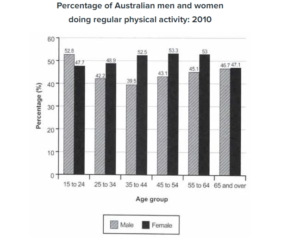
The bar chart below shows the percentage of Australian men and women in different age groups who did regular physical activity in 2010.
Sample Report
The bar chart displays the percentages of males and females in Australia in different age brackets who exercised regularly in 2010.
Overall, while women’s participation was highest in the 45-54 age bracket, that of men peaked among 15- to 24-year-olds. In addition, a higher percentage of women than men exercised regularly in every age group except the youngest.
47.7 percent of women in the lowest age bracket took regular exercise. Their participation then went up steadily with increasing age, reaching its peak in the 45-54 age group, at 53.3 percent. Above that, it started to drop, with only 47.1 percent of those in the highest age group exercising regularly.
Male participation was higher in the lowest age group, at 52.8 percent, than in any other. This was also the only group in which there was a higher percentage of males than females taking regular exercise. Men’s participation rate then fell to its lowest level among 35- to 44-year-olds, at 39.5 percent, before climbing to 46.7 percent among the over-65s. This rate was very close to that of females in the same age bracket.
At the present time, the population of some countries includes a relatively large number of young adults, compared with the number of older people. Do the advantages of this situation outweigh the disadvantages?
Sample Essay
Today, in some countries, young adults account for a comparatively large proportion of the population compared with older people. I believe the upside of this situation far outweighs its downside because young people are the main drivers of economic growth.
On the one hand, large numbers of young people can lead to high unemployment among them. Most older people already have their careers figured out. They either have stable corporate jobs or run their own businesses. In comparison, many young adults, especially those who just graduated from university, are still looking for jobs. When there are too many of them competing for the same positions, their chances of securing one are very low. However, I do not think this is a major disadvantage for young people as long as they make the leap to self-employment.
On the other hand, young people are the driving force of an economy. This is because they tend to be more productive and creative than older people, and thus are more likely to bring change and innovation to their countries. Take for example the highly innovative trillion-dollar U.S. tech industry. Most employees in this industry are only in their late 20s. I think this is a great advantage for a country because a strong economy offers people a high standard of living.
In conclusion, although large numbers of young adults can mean high jobless rates among them, I believe this disadvantage is greatly outweighed by the advantage that they can drive the economies to grow.
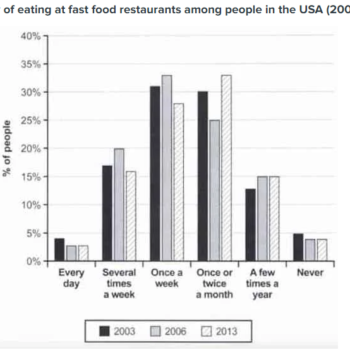
The chart below shows how frequently people in the USA ate in fast food restaurants between 2003 and 2013.
Sample Report
The bar chart displays the frequency with which people in the USA ate in fast-food outlets between 2003 and 2013.
Overall, in all three years, the two largest groups were those eating in fast-food restaurants once a week and those eating there once or twice a month. Those eating there daily and those never eating there, in comparison, accounted for the smallest proportions.
People eating in fast-food outlets once a week represented the largest segments of people in the USA in both 2003 and 2006, at about 31% and 33% respectively. However, the percentage dropped to 27 in 2013. The proportion of those who fell into the “once or twice a month” category first declined from 30% to 25% between 2003 and 2006. It then went up significantly to 33% in 2013, making this category the largest that year.
The proportion of those eating in fast-food restaurants several times a week varied between 15% and 20%, while the proportion eating there a few times a year showed an increase from 13% to 15% over the period. By contrast, in none of the three years were more than 5% of people in either the “every day” or the “never” category.
Some people believe that allowing children to make their own choices on everyday matters (such as food, clothes and entertainment) is likely to result in a society of individuals who only think about their own wishes. Other people believe that it is important for children to make decisions about matters that affect them.
Discuss both these views and give your own opinion.
Sample Essay
Some people claim that if children are allowed to make everyday decisions, society may become full of selfish individualists, while others argue that it is important for children to make up their own minds about matters that impact them. I agree with the former viewpoint because children may develop the habit of being self-centered if given the right to decide on mundane matters.
On the one hand, empowering children to make choices in their daily lives hones their decision-making skills. The reason is that if they don’t weigh their options carefully and make the right decisions, there will be consequences. For example, children who choose to indulge in ice cream every day may become overweight and be laughed at by their peers. consequently, they learn the importance of choosing healthy food over short-term pleasure. However, I do not think this is a good way to help children become better at decision-making because they are too young to be mentally strong enough to face the consequences of their bad decisions.
On the other hand, complying with all of children’s everyday wishes may result in them forming the habit of selfishness. This is because when allowed to choose whatever they want to eat or wear on a daily basis, they may become accustomed to not caring about other people’s preferences when making a decision. This habit will stay with them as they grow up, creating a selfish society. I agree with this argument because I have seen many second-generation rich children raised like this and become very self-centered adults as a result.
In conclusion, although children may become better decision-makers if allowed to decide on ordinary matters, I think this is more likely to lead them to develop the habit of selfishness, thus producing a society of self-centered individuals.
LISTENING - ONLINE TRACK CAM-12

Cambridge 12: Test 1
Cambridge 12 : Test 2
Cambridge 12: Test 3
Cambridge 12: Test 4