
Studying abroad in 2026 looks very different compared to previous years. While international students are still welcome in countries like the United States, Canada, and Australia, visa regulations have become more structured, selective, and closely monitored.
Governments are increasingly focusing on genuine students, skill shortages, and economic balance. For students planning their international education journey, understanding these updated visa policies is no longer optional — it is essential.
Let’s explore what has changed in each country and how it may impact international students.
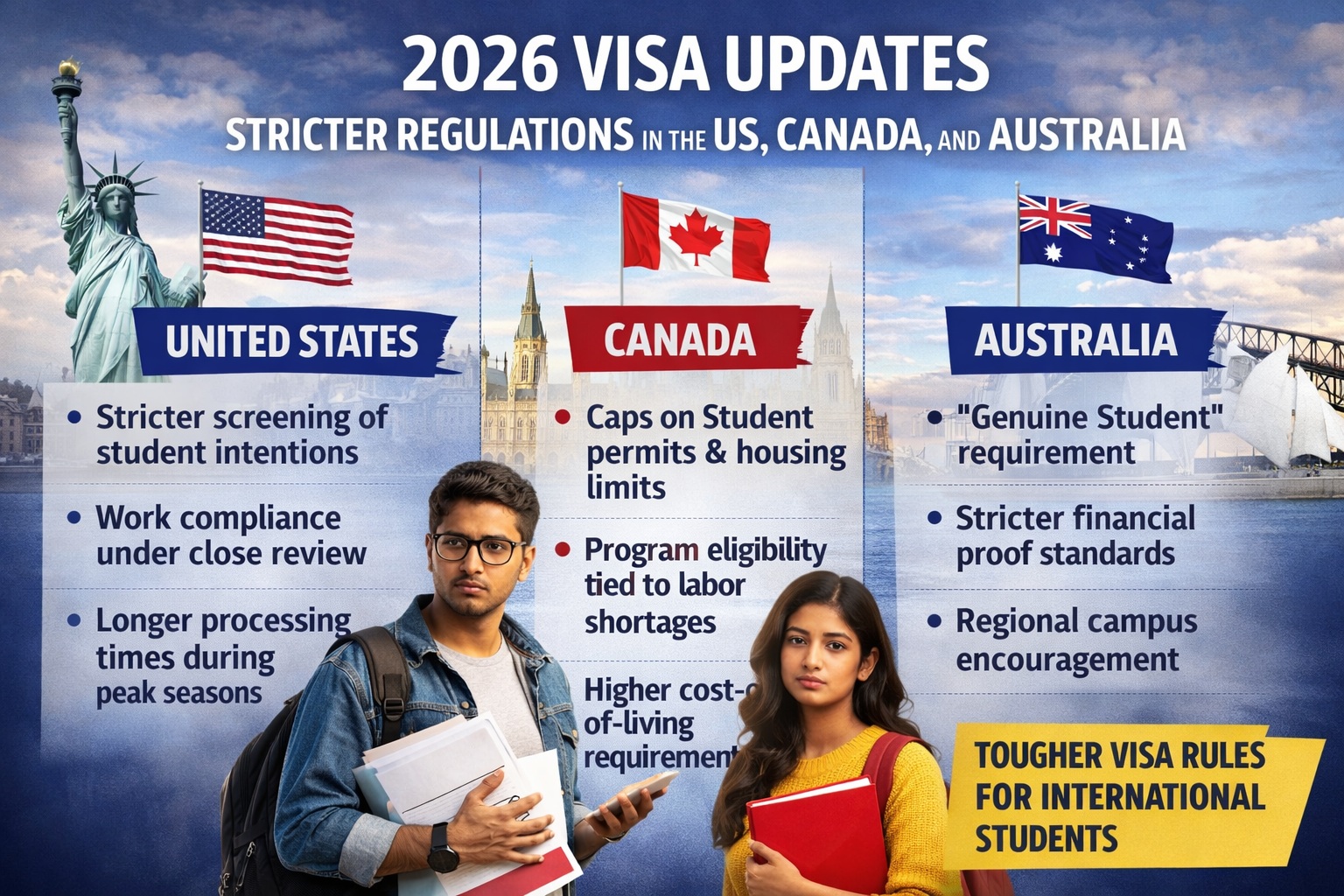
United States: Stronger Scrutiny and Clearer Intent
The United States remains one of the most prestigious study destinations in the world. Universities such as Harvard University and Stanford University continue to attract students from across the globe.
However, visa scrutiny has become more detailed in 2026.
Strong financial documentation and a clearly defined academic purpose are now critical elements of the F-1 student visa application process. Visa officers carefully assess whether applicants clearly understand their chosen program, career goals, and how the course aligns with their academic background.
Educational gaps or unclear academic plans may lead to additional questioning during the visa interview.
Another important area receiving increased attention is work compliance. While Optional Practical Training (OPT) still allows students to gain professional experience after graduation, immigration authorities are carefully reviewing employer legitimacy and whether the job is directly related to the student’s field of study.
Students must ensure that their employment strictly follows visa regulations.
Additionally, visa processing times may be longer during peak application periods, making early application planning more important than ever.
The United States continues to welcome international students, but strong preparation, transparency, and clarity of academic purpose are essential for visa approval.
Canada: Caps, Compliance, and Housing Concerns
Canada has traditionally been known for its student-friendly immigration policies, but 2026 marks a shift toward tighter regulation.
The Canadian government has introduced caps on study permits in response to housing shortages and infrastructure pressures in major cities.
Cities such as Toronto and Vancouver are under closer scrutiny due to rising student numbers and accommodation challenges. Institutions are now required to verify their enrollment capacity before issuing admission letters that qualify for visa processing.
Financial proof requirements have also increased. Students must demonstrate higher living expense funds to prove they can support themselves without depending heavily on part-time work.
Authorities emphasize that part-time employment should supplement living costs, not fully fund a student’s education.
Post-Graduation Work Permits (PGWP) remain available, but eligibility is increasingly linked to program type and institutional recognition. Programs related to labor shortages — such as healthcare, skilled trades, and technology — are receiving greater priority.
Students enrolling in private colleges or non-priority programs may face limited post-study work opportunities.
Canada still values international talent, but the focus has shifted toward sustainability, genuine enrollment, and alignment with labor market needs.
Australia: Stricter Genuine Student Requirements
Australia has introduced some of the most noticeable student visa reforms in 2026.
The new Genuine Student (GS) requirement has replaced earlier assessment frameworks. This policy ensures that applicants are primarily motivated by education rather than migration alone.
Major cities such as Sydney and Melbourne remain popular study destinations, but the government is encouraging students to consider regional campuses, where skill shortages are more significant.
English language score requirements have increased for certain programs, particularly vocational and postgraduate courses.
Financial documentation standards have also become stricter. Authorities now carefully assess the source of funds and sponsor relationships.
Students are still allowed to work during their studies, but monitoring of work compliance has increased. Authorities are ensuring that students do not exceed permitted working hours and that employers follow fair wage regulations.
In addition, institutions with historically high visa refusal rates are now under greater scrutiny.
Australia is clearly signaling that it welcomes serious and academically committed students who intend to contribute to priority industries.
What These Changes Mean for Students in 2026
Across the United States, Canada, and Australia, one clear pattern is emerging.
Governments are not closing their doors to international students. Instead, they are introducing stricter measures to ensure quality, compliance, and long-term sustainability.
Students now need to prepare more carefully than ever before. This includes:
- Choosing recognized institutions
- Providing clear financial documentation
- Demonstrating genuine academic intentions
- Preparing strong visa interview responses
Last-minute applications, weak documentation, or unclear study plans may result in visa delays or refusals.
However, well-prepared students who present clear goals and strong academic motivation continue to succeed.
Although visa policies have become stricter, studying abroad remains a valuable and achievable opportunity. With proper preparation, detailed research, and a realistic understanding of regulations, students can still successfully pursue their dreams of studying in the United States, Canada, or Australia.


